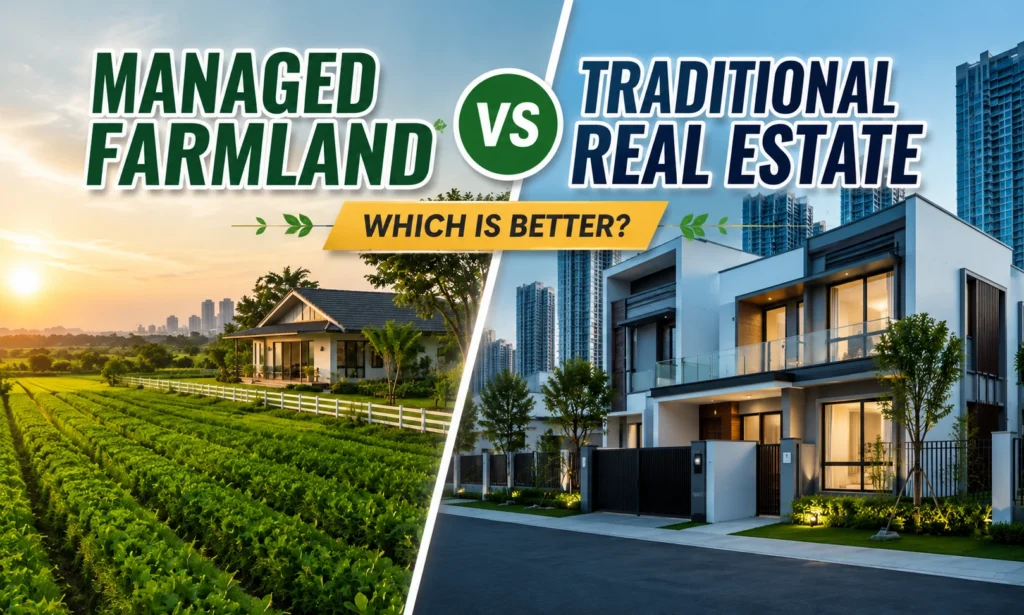
The urban real estate investment is changing, and people are now getting interested in managed farmland instead of traditional rental homes, land, or apartments. But does it mean you should buy apartments in big cities?
Absolutely NOT!
The urban real estate market is as green as it ever was. It’s still one of the most profitable investment options. Apartments, plots, and commercial spaces have helped many investors build long-term wealth. However, people are also looking for managed farmland investment because of the rising property prices, lower rental yields, and increasing maintenance costs.
Managed farmland is different from agricultural land and is managed by professional experts to handle all the processes:
- Farming
- Irrigation
- Maintenance
- Crop management
Companies like Mytan Farms are developing farmland accessible even for people who have zero experience of managing farmland.
But the question is whether you should choose managed farmland vs real estate?
What is Managed Farmland?

A managed farmland investment is a property that is owned by the investors but is managed by a farmland management company. The company takes care of everything, including:
- Land preparation
- Crop planning
- Irrigation management
- Soil improvement
- Plantation
- Harvesting
- Marketing of produce
- Property maintenance
Many farmland management companies also develop:
- Internal roads
- Drip irrigation systems
- Water harvesting infrastructure
- Security
- Boundary fencing
- Farm management services
The company manages the farm and takes a share of the total profits. Notably, the investors can utilise the farm for multiple sources of income, such as:
- Crop sales
- Fruit orchards
- Timber plantations
- Leasing opportunities
- Rising Land value
Moreover, investors can also enjoy their farmland as their weekend holiday space.
What is Traditional Real Estate?

Traditional real estate means:
- Residential apartments
- Residential plots
- Villas
- Commercial offices
- Retail shops
- Warehouses
These are regular real estate investments and need a higher capital amount at the beginning.
Advantages of Traditional Real Estate:
- Long-term appreciation
- Physical asset ownership
- Possibility of rental income
- Easier financing through home loans
Challenges of Traditional Real Estate:
The traditional real estate has several challenges that you must consider:
- High purchase prices
- Registration and stamp duty expenses
- Tenant management
- Maintenance costs
- Vacancy periods
- Society charges
- Repairs and renovations
These are some of the common issues happening every now & then. They also cost a lot of money sometimes. According to a report, Indian cities offer 2-4% of annual rental yield, which means most investors earn from selling the property at high prices rather than just renting.
Comparison between Managed Farmland vs Traditional Real Estate:
| Factor | Managed Farmland | Traditional Real Estate |
| Entry Cost & Affordability | Lower entry point — you can start with much less capital. Attractive for young professionals, first-time investors, NRIs, and portfolio diversifiers. | Higher upfront investment. A metro-city apartment can cost anywhere from ₹70 lakh to several crores. |
| Appreciation Potential | Driven by water availability, soil quality, nearby development, and agricultural productivity. Farmland near a city can gain from both productivity and land value. | Driven by infrastructure development, demand, government regulations, and local supply. |
| Maintenance Effort | Handled end-to-end by professional teams — irrigation, crop care, pest control, security, and harvesting. No day-to-day involvement needed. | Owner manages plumbing repairs, painting, legal documentation, vacancy, and tenant complaints. |
| Passive Income Potential | Multiple income streams — fruit orchards, organic farming, plantation crops, crop sharing, and farm leasing, plus land appreciation. | Primarily rental income, typically 2–4% annual yield in Indian cities. |
| Liquidity & Exit | Considered illiquid; sale needs legal checks and depends on state rules. Some managed-farmland companies assist with legal and resale support. | Also illiquid; legal checks and state regulations apply, and sales can take several months. |
| Risk Factors | Weather variability, crop diseases, water availability, and agricultural market prices. | Market slowdowns, oversupply, vacancy, tenant disputes, regulatory changes, and rising maintenance costs. |
| Tax Treatment & Regulations | Agricultural income treatment and ownership structure, subject to applicable state and central laws. Several states have specific rules on agri-land ownership and transfer. | Stamp duty, registration charges, property tax, capital gains tax on sale, and rental income taxation. |
Income Potential of Managed Farmland and Real Estate:
The source of income is a major difference between managed farmland vs real estate.
Rental Income:
Ranges from 2-4% annually and depends on:
- Tenant demand
- Property location
- Maintenance quality
- Vacancy periods
Farm Revenue
Offer multiple income resources such as:
- Fruit cultivation
- Vegetable farming
- Medicinal plants
- Timber plantations
- Organic produce
- Agroforestry
In addition, good farmland also enjoys land appreciation income.
What Should You Choose between Managed Farmland and Traditional Real Estate?
Choose traditional real estate if you want:
- Residential ownership
- Loan financing
- Urban assets
- Plan to live in the property later.
- Understand property management
Choose managed farmlands if you want:
- Passive ownership
- Lower entry costs
- Portfolio diversification
- Sustainable investments
- Have no farming experience
- Not to manage operations.
The best way is to diversify your investment instead of putting it all in a single asset. This helps you get multiple investment resources and earn from multiple places, such as:
- Equity investments
- Fixed-income assets
- Gold
- Urban real estate
- Managed farmland
It also helps you balance the risks and create secure long-term wealth.
Why is Mytan Farms a Smart Managed Farmland Choice?
If you want to invest in agricultural land, remember this. Choosing the right management partner is as important as choosing the land itself. Mytan Farms offers several benefits to you, such as:
- Agricultural management
- Scientific farming practices
- Irrigation infrastructure
- Regular maintenance
- Transparent ownership process
- Guidance for first-time investors
- Choosing the right farm locations.
Mr. Harish Babu M L, the founder of Mytan Farms has more than 22 years of experience as a research Scientist & Head-Project Management in multiple global pharmaceutical MNCs. With a concept of 3Ps: Profits, Passion and Planet, he leads the Mytan farms with professionals, offering practical and convenient solutions for crop management, operation management, and long-term wealth creation for investors.
Suggested Read: Complete Guide to Buying Farmland Near Bangalore — everything you need to know before making your first purchase.
Conclusion:
In this blog, we have discussed managed farmland vs real estate but it’s not really about what’s universally better. It’s more about what aligns with your immediate goals. Before you make the decision, consider factors such as:
- Financial goals,
- Investment horizon, and
- Involvement level.
Both managed farmlands and traditional real estate are valuable assets for investors. However, managed farmland investment offers lower entry costs, professional management, multiple income sources, land appreciation, and an opportunity to enjoy a calm livelihood.
If you are a complete beginner, the best investment would be managed farmland near Bangalore This will offer a natural growth to your land value while keeping your farm as a primary asset.
Want to explore more about managed farmland projects with professional farm management for long-term growth?
Explore Mytan Farms managed farmland projects for a smart investment portfolio.
FAQs:
Is managed farmland a safe investment?
Yes. Professionally managed farmland often reduces your operational challenges and offers expert farming, irrigation systems, and ongoing maintenance. But like everything, it also has risks such as weather conditions, crop performance, and market fluctuations.
How is managed farmland different from buying a plot of agricultural land?
In a managed farmland investment, a professional team handles all your farming, maintenance, irrigation, crop management that is never available with traditional agriculture land.
Which gives better returns: real estate or managed farmland?
The returns depend on the location, market conditions, project quality, and holding period. Traditional real estate relies on appreciation and rental income. On the other hand, managed farmland may have both agriculture and land income.
Do I need farming experience to invest in managed farmland?
No. One of the biggest advantages of managed farmland investment is that you can have it without any farming experience.
Can I generate regular income from managed farmland?
Yes. Managed farmland investment may generate multiple regular income sources such as crop sales, fruit orchards, leasing arrangements, or other agricultural activities. Alongside, it may also offer long-term land appreciation.