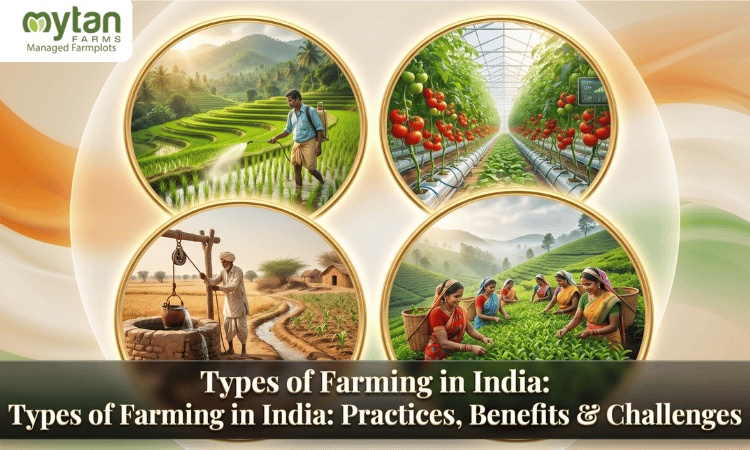
India is an agricultural country where farming is not just a profession. Farming is a way of life. Not only small villages but also large rural regions are earning income through agriculture. Agriculture and Allied Sectors contribute approximately 16%-18% to the country’s economic income (GDP).
Farmers have always done the farming in traditional methods but the rising population and advanced technology have completely changed it. Now, farmers use modern techniques in agriculture today to increase production and meet food demand.
Understanding the various types of farming in India is important to boost agricultural production, conserve natural resources, and increase income. This goes beyond traditional farming methods and offers a sustainable, technology-driven farming solution. They address modern challenges such as climate change, diminishing arable land, and water scarcity.
What Do You Mean Types of Farming in India?
In India, there are various agricultural techniques that farmers adopt. The techniques depend on weather conditions, soil characteristics, water resources, the size of their fields and their intended crop uses. So, farming using various techniques is ‘types of farming’ in India.
Major Types of Farming in India:
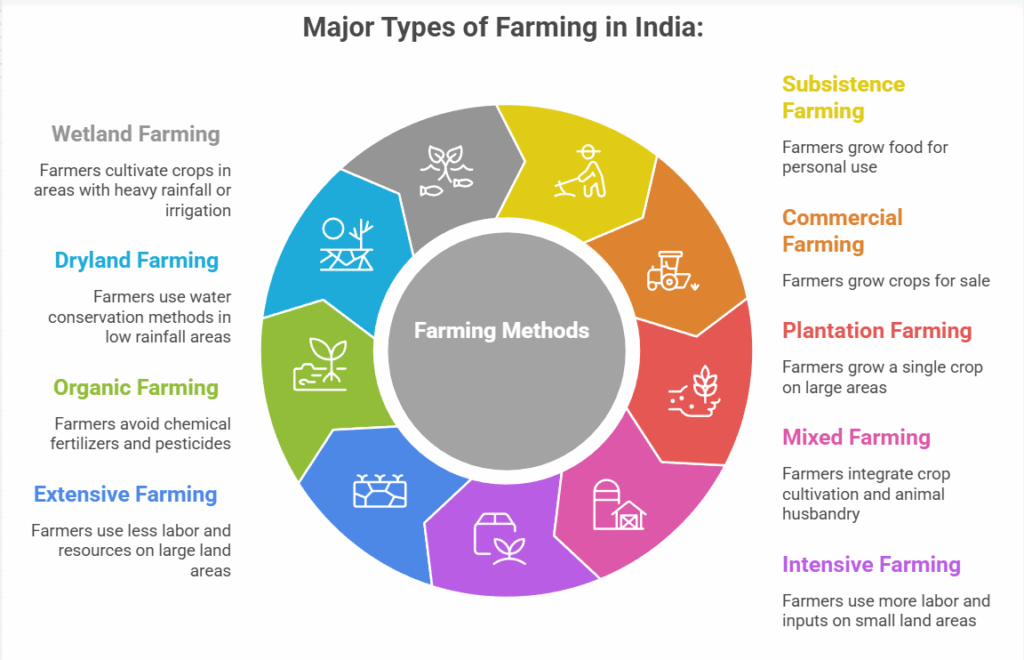
India has a wide range of farming methods because of different geographical areas. Each farming method has its own distinct function which matches specific environmental conditions.
Here are major types of farming in India:
- Subsistence Farming in India
Small-scale farmers who grow their own food for personal use operate subsistence farming. In this type of farming, the focus is not on profit but on meeting the needs of the family. Farmers use traditional tools and simple techniques in this farming.
Subsistence farming occurs in rural areas where land ownership exists. The common practice included in the farming is growing rice together with wheat, pulses and various vegetables. The farming faces two main obstacles and that are low output and insufficient access to contemporary technology.
Pros:
- Ensures food for family
- Low investment required
- Uses local resources
- Less risk of market loss
- Simple farming methods
Cons:
- Low productivity
- No surplus income
- Dependent on monsoon
- Limited use of technology
- Poor living standards
- Commercial Farming in India
In commercial farming, the farmers grow commercial crops to sell them at market. They utilize contemporary machinery together with chemical fertilizers, high-yield agricultural seeds and irrigation systems to enhance their crop yields.
The practice of this farming method occurs in states that possess advanced transportation networks. The agricultural system produces large amounts of cotton, sugarcane, wheat and maize. The farming increases revenue for the business but requires substantial financial resources.
Pros:
- High production
- Good income potential
- Uses modern technology
- Market-oriented
- Efficient use of resources
Cons:
- High investment needed
- Risk of market price fluctuation
- Environmental damage due to chemicals
- Requires skilled knowledge
- High dependency on inputs
- Plantation Farming in India
Farmers grow a single crop on a large area in Plantation Farming. The farming needs extensive management together with substantial financial backing.
Farmers grow crops such as:
- Tea
- Rubber
- Coconut, etc.
Farmers do plantation farming in specific climatic zones such as Assam, Kerala and Karnataka. This farming plays a major role in international trade.
Pros:
- High export value
- Large-scale production
- Organized farming system
- Generates employment
- Good profit margins
Cons:
- High capital investment
- Depends on climate conditions
- Monoculture risk
- Soil depletion over time
- Requires skilled labor
- Mixed Farming in India
Mixed farming operates through agricultural methods which integrate both crop cultivation and animal husbandry. The farmers cultivate various crops while simultaneously raising different animal species which include cows, goats and poultry in mixed farming.
The farming method enables farmers to generate multiple income streams while simultaneously decreasing their operational hazards. Farmers can use livestock as a backup source of income when their crops do not succeed in farming. This enables natural manure to enhance soil fertility.
Pros:
- Multiple income sources
- Reduces risk
- Efficient resource use
- Improves soil fertility
- Continuous income
Cons:
- Requires more management
- Labor intensive
- Needs knowledge of both crops and livestock
- Initial setup can be costly
- Time-consuming
- Intensive and Extensive Farming Practices
Farmers implement intensive farming methods in locations which experience both high population growth and restricted agricultural land. Farmers use more labor, fertilizers, and irrigation to increase yield from small land areas.
In extensive farming, farmers work in regions which have ample land and few inhabitants. The farming requires less workforce together with fewer resources. It results in decreased output that extends over an extensive area.
Pros:
- High yield per area
- Efficient land use
- Supports large population
- Use of modern inputs
- Multiple cropping possible
Cons:
- Soil degradation
- High input cost
- Environmental pollution
- Overuse of fertilizers
- Requires constant monitoring
- Organic Farming in India
Organic farming eliminates all chemical fertilizer and pesticide applications from agricultural operations. The method employs natural techniques which include compost application, green manure usage and biological methods to control pests.
The farming experiences increasing demand because more people understand health benefits and environmental protection methods. It generates chemical-free food products which initially result in lower production levels.
Pros:
- Low input cost
- Less labor required
- Simple management
- Suitable for large lands
- Lower stress on resources
Cons:
- Low yield per unit area
- Requires large land
- Less efficient land use
- Lower profitability
- Depends on natural conditions
- Dryland and Wetland Farming
Dryland farming exists in regions which receive insufficient annual rainfall. The farmers use water conservation methods to cultivate millet pulses and oilseeds.
Farmers do wetland farming in the regions where people see heavy rainfall or have effective irrigation systems. The area supports the cultivation of rice and jute. These farming types depend heavily on water availability.
Pros:
- Suitable for low rainfall areas
- Low investment
- Uses drought-resistant crops
- Promotes water conservation
- Sustainable in dry regions
Cons:
- High risk of crop failure
- Low productivity
- Dependent on rainfall
- Limited crop options
- Soil moisture issues
Benefits of Different Types of Farming in India:
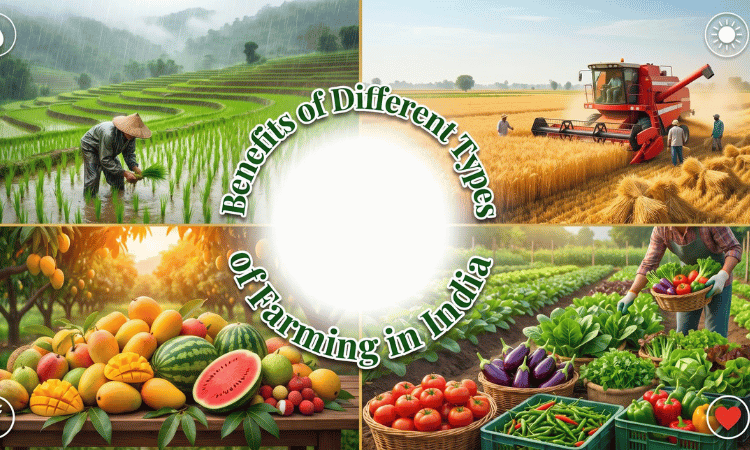
Here are the benefits of different types of farming in India:
- Provides food security for the growing population
- Creates employment opportunities in rural areas
- Supports economic growth of the country
- Encourages crop diversity and reduces risk
- Helps in better use of land and resources
- Promotes sustainable and eco-friendly practices
- Supports livestock and dairy industries
- Boosts export of agricultural products
Key Challenges Faced by Farmers in India:
Here are the key challenges faced by farmers in India:
- Dependence on unpredictable monsoon rainfall
- Small and fragmented land holdings
- Lack of access to modern technology
- High cost of seeds, fertilizers, and equipment
- Poor irrigation facilities in many regions
- Market price fluctuations and low profits
- Limited access to credit and financial support
- Soil degradation and declining fertility
Government Initiatives Supporting Indian Farming:
The Indian government has implemented multiple programs which assist farmers while boosting agricultural output. The PM-Kisan program delivers financial support to farmers. It enables them to handle their costs and fund their agricultural work.
The Government’s Crop Insurance schemes also protect farmers from losses due to natural disasters. It is backing organic farming programs which include irrigation infrastructure development and modern technology adoption.
The government is implementing digital platforms together with agricultural training programs. They help to educate farmers about better farming techniques. It will boost productivity throughout the entire industry.
Future of Farming in India:
The future of Indian farming presents an optimistic outlook because farmers will adopt technological advancements together with innovative farming methods. Agriculture undergoes transformation through precision farming techniques with drone technology and smart irrigation systems. It enables farmers to boost their output while they spend less money and use fewer natural resources.
We today recognize environmental problems which make sustainable farming practices more valuable. The government supports eco-friendly farming methods which farmers are starting to adopt. These methods will bring them financial benefits. The agricultural sector will achieve economic growth through these practices because they deliver results which maintain stability.
Conclusion:
There are various types and methods of farming that exist in India. Here, agriculture represents the core of the country’s economic system. The different farming methods from subsistence to commercial and organic farming all contribute their own particular functions. They help fulfill dietary requirements while creating revenue streams.
Today, the agricultural sector needs to address numerous issues which still exist. Agricultural growth in India will achieve greater stability and profitability through government backing modern technological advancements and environmentally friendly farming techniques. Agricultural development will create advantages for farmers which will drive national prosperity.
FAQs:
- What are the main types of farming in India?
The main types of farming in India are subsistence, commercial, plantation, mixed, organic, intensive, extensive, and dryland and wetland farming. Note that each farming type depends on the climate, land, and purpose of production.
- Which type of farming is most profitable in India?
Commercial and plantation farming are generally more profitable in India due to large-scale production and market demand. The profitability of a business depends on its operational area, the specific crops grown and the money invested.
- What is the difference between subsistence and commercial farming?
Subsistence farming exists to create food for personal use at home while commercial farming produces agricultural products that farmers sell to make money through market distribution.
- How does climate affect farming types in India?
Farming types depend mainly on climate conditions. Wetland farming exists in areas that receive abundant rainfall while dryland farming uses drought-resistant crops in dry regions.
- What are the major challenges faced by Indian farmers today?
Major challenges faced by Indian farmers today include unpredictable weather, small land holdings, high costs, low market prices, lack of technology, and poor infrastructure.